From the Shopify checkout to the courier, one traceable lifecycle.
Commerce Operations Platform
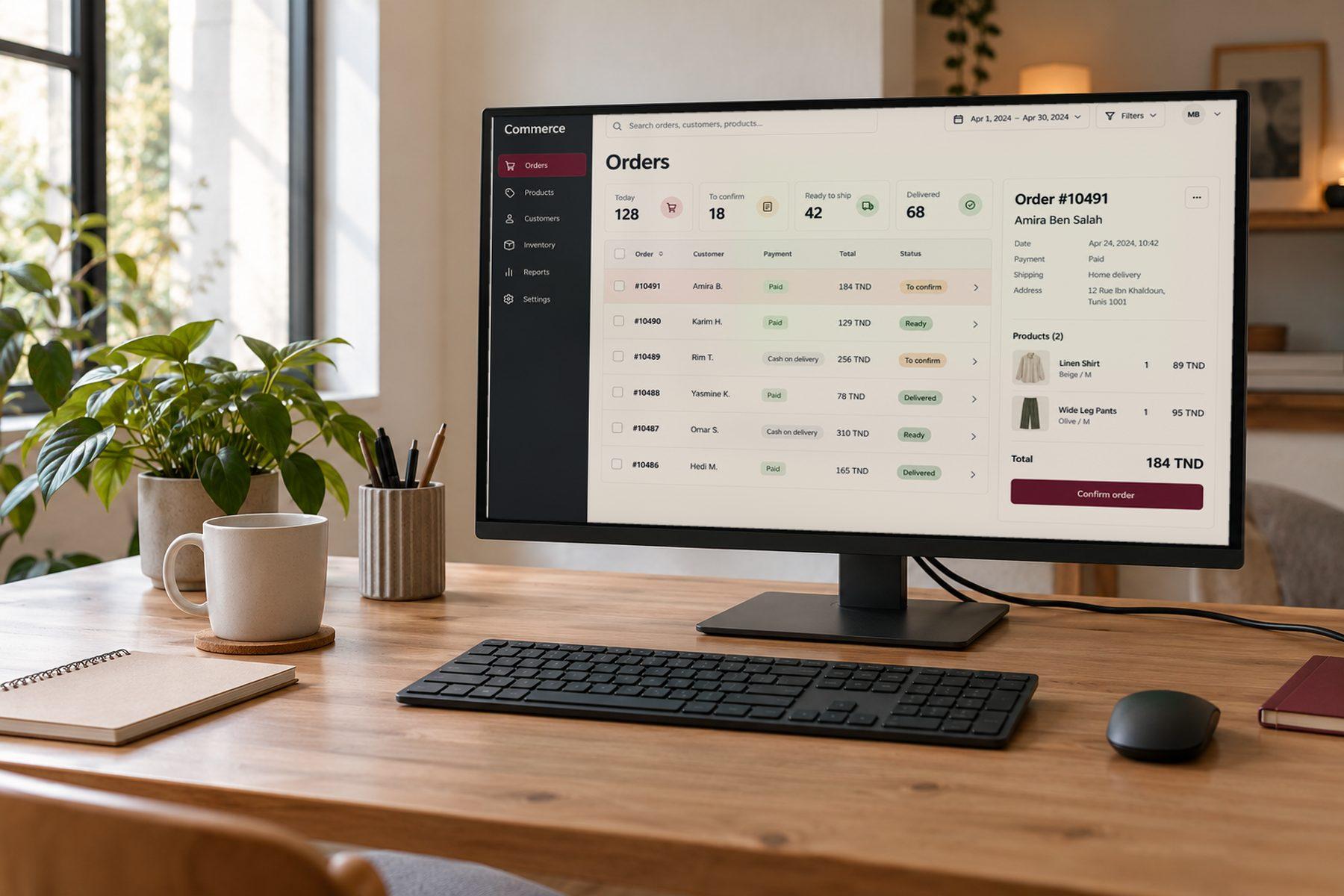
Shopify orders, confirmation, stock, barcode-verified packing and delivery handover run from one operations console.
- Category
- Connected commerce
- Industry
- Retail & e-commerce
- Work type
- E-commerce, Automation, Integrations
- Service
- E-commerce & Shopify
- Stack
- Shopify Admin API, Webhooks, Node.js, PostgreSQL, React
01Context
A direct-to-consumer brand selling through Shopify with a high share of cash-on-delivery orders. Every order is confirmed by phone before it is packed, and handed to local couriers for delivery.
The business problem
The storefront captures the sale. Confirmation calls, stock allocation, packing and courier handover happened in separate tools, so exceptions were hard to trace and easy to duplicate.
What we built
Centralised order operations synchronised with Shopify: a confirmation queue, stock reservation, barcode-verified pick and pack, packing documents, courier handover and role-based views for each team.
02System architecture
Systems, flows and the boundaries between them.
- Service
- System of record
- External system
- Gate
- Asynchronous
- 1Shopify store to Webhook receiverSigned webhook
- 2Webhook receiver to Order state machineDeduplicated order event
- 3Shopify Admin API to ReconcilerPaginated GraphQL reads
- 4Reconciler to Order state machineMissed or out-of-order changes repaired
- 5Order state machine to Confirmation queueOrder awaiting confirmation
- 6Order state machine to Pick and packConfirmed order released to packing
- 7Order state machine to Stock ledgerReserve on confirm, release on cancel
- 8Pick and pack to Courier APIHandover manifest and labels
- 9Courier API to Order state machineDelivery status updates · async
Components: Shopify store (External system, orders/create · updated); Shopify Admin API (External system, GraphQL reads); Webhook receiver (Service, HMAC · idempotency key); Reconciler (Service, scheduled diff); Order state machine (System of record, guarded transitions); Confirmation queue (Approval or permission gate, call attempts · outcome); Pick and pack (Service, barcode-verified); Stock ledger (System of record, reserve · release); Courier API (External system, label · status).
Major capabilities
- Confirmation queue
- Call attempts, outcomes and callbacks recorded per order, with automatic cancellation after the last attempt.
- Stock reservation
- Confirmed orders reserve stock per SKU; cancellations and returns release it through the same ledger.
- Barcode-verified packing
- Each item scanned against the order before a parcel can be closed.
- Courier handover
- Manifests and labels generated per courier, delivery status fed back into the order.
- Role-based views
- Confirmation, warehouse and management each see the slice of the lifecycle they act on.
03Engineering approach
The decisions that shaped the system.
We treated the order as a state machine with explicit, guarded transitions, and made Shopify one input to it rather than the place where operations live. Webhooks, scans and courier updates all become events against the same order.
- 01
The order is a shared state machine.
Every team moves the same order through defined transitions, so an exception has one place to live and one history.
- 02
Idempotent webhooks, reconciled against Shopify.
Shopify retries and can deliver out of order. Each event is keyed and applied once; a scheduled reconciler repairs anything missed.
- 03
Scans are the source of truth for what shipped.
A parcel cannot close until every line has been scanned, so the system records what left the warehouse, not what was intended.
04Workflow
Order lifecycle
Six states every team shares, and the exceptions each one is allowed to raise.
- 1ReceivedWebhook verified and keyed
- 2ConfirmedCustomer reached by phoneUnreachable
Three attempts, then cancelled and stock released
- 3ReservedStock held per SKU
- 4PackedEvery line scannedScan mismatch
Parcel blocked until the wrong item is replaced
- 5With courierManifest signed offReturned
Inspected, restocked through the ledger
- 6DeliveredStatus from courier
05Integration complexity
What each connection has to survive.
| System | Interface | What makes it hard |
|---|---|---|
| Shopify | Webhooks, Admin GraphQL API | At-least-once delivery with no ordering guarantee; edits after checkout arrive as separate events. |
| Couriers | REST APIs and manifest files | Each courier has its own label format, status vocabulary and failure modes. |
| Warehouse scanners | Browser-based barcode input | Scans happen fast and offline moments occur; input must be validated without slowing packers down. |
06Challenges solved
Problems we had to design around.
- 01
Duplicate webhooks created duplicate work.
Idempotency keys on every event, with a reconciler comparing local state to Shopify on a schedule.
- 02
Stock was decremented in more than one place.
A single ledger: every reservation, release and restock is an entry tied to an order transition.
- 03
Wrong items reached customers.
Barcode verification per line, with the parcel blocked until the scan matches the order.
07Outcomes
Every order follows a single lifecycle from storefront to delivery, and duplicate or out-of-order webhooks reconcile instead of creating double work.
Outcomes are described at capability level. Client figures stay with the client.
- Each order has one lifecycle and one history, from checkout to delivery.
- Webhook retries and late events are absorbed instead of creating duplicate orders.
- Packing errors are caught at the scanner, before the parcel is handed over.
Relevant services
Bring us the process everyone works around.
The spreadsheet that runs the business, the inbox nobody can leave, the integration that breaks quietly. Tell us where operations slow down and we will show you how we would engineer it.
What happens next
- 01A conversation with the engineers who would build it.
- 02A short written view of the problem and how we would approach it.
- 03A scoped proposal, if working together makes sense.